Translate

Mostrando postagens com marcador resistance. Mostrar todas as postagens

quinta-feira, 25 de junho de 2015

Gender Ideology-Betrayal: Parishes in Brazil at the service of the destruction of the Church

By Catherine Maria B. de Almeida | Fratres In Unum Translation and Commentary by Michael Fuller- 
{Note: Fratres In Unum is a pseudo-traditionalist site which promotes diocesan Masses. They are trad-ecumenist and similar to Michael Voris.  They do a lot of good denouncing the abuses in the conciliar church, but fail to see the real problem.  They have also unwittingly used the language of the sodomite agenda and my comments appear in red.}


According to news published on Monday, the parish of Our Lady of Mount Carmel, the Diocese of São Miguel Paulista - São Paolo, Brazil, presented a set of prayers in its weekly liturgical "Memorial of the Lord" in which they beseeched God for the gay [sodomite] cause.

Faithful from all over Brazil were offended by the prayers, calling for "the offensive, homophobic and hysterical fundamentalists in Congress to be confronted with courage and serenity by the rise of libertarian causes", a clear pledge of allegiance to the LGBT flags.

It is worth noting that at no time did they show themselves to be embarrassed by the scandal to the faithful.  The IPDM Association, "Igreja, Povo de Deus em Movimento-the Church, the People of God in Movement-liberation theology", linked to the parish, even released a statement saying that they had published "the prayer of the faithful made in the Divine Office in celebration of Our Lady of Mount Carmel", but "the parish, the priest and all of the community of believers were subsequently attacked by Catholic fundamentalists"(sic!).

The prayers were authored by Fr. Paulo Sérgio Bezerra, parish priest of that parish and priest of the Diocese of São Miguel Paulista. It is not, however, an isolated offense. The same priest wrote a theological apologetic of homosexuality, published in two parts (here the first and second parts).

The main thesis that he defends is that "'Catholicism and homoaffectivity [a new language term of the sodomite agenda to remove shame and guilt for unnatural attractions]' historically clashed and opposed each other. As a result of this the 'fires of the inquisition' were lit and 'heated debates', mostly producing perpetrators and victims.  Liberation theology proposes to discuss it".

However, this association is not limited to a theoretical defense.  It is also militant and has very clear goals!

Now, in a video [see above] found on the City Council's site in São Paulo, the intentions of this movement are made blatantly public.

One [pro-sodomite] named Eduardo Brasileiro introduced himself in a seminary organized by the LGBT Movement and others, explaining who the Association "Church, the People of God in Movement" are and what they want:

"It is a movement within the Catholic Church that wants to fight for human rights by a refounding of dogma and Catholic conceptions within its power structure. This is not easy, but it has fifteen parishes of São Paolo East Zone who share this idea."

The video is shocking because in addition to nominally confronting the Cardinal/Archbishops of São Paulo and Rio de Janeiro, the guy praises the blasphemous representation of the crucified transvestite (This occurred in the sodomite pride parade that the diocese of São Paolo strongly supported, see more in my other article on Gender Ideology here. What is stated is praising of the blasphemy and he says that it was a good thing that they committed this blasphemy to show that other people suffer and that there should be more taking of these religious symbols and desecration of them.  It is truly shocking.).

Well, something must be done. And it is urgent !!

This is a tactic used to destroy the Church. To instrumentalize it, infiltrating enemy groups, with the aim of breaking them down gradually from within.

This is the case, for example, of "Catholics for a Free Choice". As was confessed by its founder, Frances Kisslling, the objective of the association was to erode the Catholic morality from within the Church to undermine the anti-abortionist resistance, since Catholic moral theology was the most articulate position and offers sound arguments against the Culture of Death . In the words of Kisslling:

"People in this country have questioned the legality of abortion, but in a way that did not question the issue of morality. Failure to address this issue at the moral level is a serious threat to the long-term success of the movement in favor of abortion. You never really will definitely win if the question of morality is raised. If we, as a movement, we have to deal with morality on abortion, we will lose, because the moral discourse is controlled by men and religion, and is built against women. The argument of the bishops says that abortion is murder, that abortion is murder and that life begins at conception. But it is this Catholic perspective that is the right place where to begin the work, because the Catholic position is the most developed. So, if you can disprove the Catholic position, you have debunked all the others. None of the other religious groups actually have statements as well defined on the personality, when life begins, fetuses, etc. So, if you bring down the Catholic position, you win. "

{Let me quote some more that was not quoted but is important in this context: "Abortion is killing, life begins at conception. They don’t say personhood begins at conception. They themselves would never dare say that. So our job has been to take on this question forthrightly from a Catholic perspective, although you can then extrapolate from the Catholic perspective to other perspectives. You know, the Catholic perspective is a good place to start—in either philosophical, sociological, theological terms—because the Catholic position is the most developed position. So if you can refute the Catholic position, you have refuted everything else. Okay. I mean, none of the other faith groups really have as well-defined statements on personhood, when does life begin, fetuses, et cetera. So by debunking the Catholic position, you win. To go back, for instance, to how do you deal with the ultimate loyalist—so Population and Reproductive Health Oral History Project Sophia Smith 

"I’m out, and I’m making a speech, and always, the end of my speech, you
know, there are always a few people in the audience who are of this Opus Dei
ilk—whether they belong to Opus Dei or not, they’re Opus Dei–ilk Catholics.
And they’ll stand up and they’ll say, This woman has excommunicated herself. Why are you listening to her? She is not a Catholic. You cannot be a Catholic and have this position.

"And my response is actually to turn the loyalty question on its head, so to speak, and I say to them, Look, I’m always fascinated by people like you because you claim to be loyal to the Pope, and that the Pope makes the rules. Now, the Pope and the bishops, my bishop in Washington, D.C., have not said I am not a Catholic. They are the ones who decide who is excommunicated. You don’t get to decide. And if you are so loyal to the Pope and the bishops, how dare you take upon yourself as a lowly lay person the right to say that I am excommunicated. That is not your right. And our bishops and our Pope have, for whatever reasons, decided that excommunicating Catholics who disagree with them on the question of abortion is not what they’re going to do, and I would say they’re not going to do it because they don’t have the right to do it. I am sure it frustrates them, the bishops, that they can’t go out there and excommunicate all of us, because it would just be so easy to end this dissent within the Church by taking that action. But even they, in the service of something they believe so profoundly, will not pervert the structure of the institutional Church and misuse excommunication to deal with this problem. So it shows—if they could excommunicate us, they would do it tomorrow." {You find all of this here. You will see more relevance of this added quote near the end of this article}

This Association "Church, the People of God in Movement" introduces itself with the same purpose: to destroy the Catholic dogma from within, deceiving the people by preaching a false gospel, in open disagreement with the Church's teaching, to promote the agenda of anti-Catholic groups, such as LGBT and other organizations clearly linked to lobbies against life and the family.

The Code of Canon Law [new] says that "who joins an association which plots against the Church is to be punished with a just penalty; however, a person who promotes or directs an association of this kind is to be punished with an interdict" (c. 1374).

But above all, it states that "an apostate from the faith, a heretic or schismatic incurs excommunication latæ sententiæ" (c. 1364), and "by the law itself", that is, without the need of intervention of an ecclesiastical authority, "is removed from office"(c. 194). "The removal" adds the canon "can be enforced only if it is established by the declaration of a competent authority" (c. 194 §2), i.e. only the ecclesiastical authority may apply the material consequences of the loss of office, but the loss itself takes place under the law, regardless of the intervention of the competent authority.

The theological reasons for these canonical determinations are clear if we consider the constant tradition of the Church, exemplified, among other sources, in the Encyclical Mystici Corporis of Pius XII. As taught by the Pontiff, "For not every sin, however grave it may be, is such as of its own nature to sever a man from the Body of the Church, as does schism or heresy or apostasy". (Pius XII, SS, Encyclical MysticiCorporis, 29.06. 1943, no. 22). In other words, by mortal sin, generally speaking, the Christian loses sanctifying grace, the virtue of charity, all the other virtues and gifts of the Holy Spirit, but he will continue with the virtue of faith. It remains dead, and he himself will become a dead member of the Church, nevertheless, a member of the Mystical Body of Christ, even though a dead member.

But when someone sins against faith, falling into heresy [formal heresy], they lose the virtue of faith and are no longer a member of the Mystical Body of Christ. He is no longer even a dead member of the Church; he no longer is part of it, and neither is he Christian. Obviously, if someone no longer belongs to the Church, one cannot be understood to exercise an office in which one would govern over others in the faith. With assistance from the competent authority or without it, you have the loss of office even if only by the law itself.  For the authority, the only thing done is to legally require the material consequences of the loss, as the physical removal of office and replacement.

Applying this to the current case, Father Paulo Sergio Bezerra is blatantly in conscious heresy, putting himself in frank disagreement with Sacred Scripture and the teaching of the Church, which consider homosexuality a grave sin; He is automatically excommunicated and loses ipso facto his ecclesiastical office and his condition as member of the Church.

And this Association also conspiring against the Church, must be denounced and suppressed.  Its members should be urged to rectify their position and in the case of adhereing to them,  their excommunication must also be declared because of their blatant heresy. [It almost seems that the Fratres In Unum blog, which makes a big deal about official, conciliar recognition, has left out this important quote from the subversives that I included regarding how the question of authority is actually being used against Catholics who demand adherence to doctrine.  This is because Fratres in Unum takes the middle ground, excommunicating liberals and modernists and claiming that traditionalists are disobedient.  They want their cake and to be able to eat it too.  It's time that they learned that the "loyal to the pope flavor of traditionalists" crowd can't have it both ways.  Don't expect them to wake up though. Bishop Rifan will just say something conservative soon to pacify them.]

The Catholic faithful have a duty to report these usurpers to the ecclesiastical authorities, which have a duty to intervene, applying the law of the Church.       [Where have they been?  The authorities of the Church have been accomplices for the last 40 years.  These guys are deluded by their neo-conservatice, conciliar trad views.]

As taught by St. Thomas, the faithful must not use tolerance toward those who teach in the Church and spread errors against the faith, and for that reason no longer belong to it. "When there is danger to the faith", says St. Thomas,

"It must be observed, however, that if the faith were endangered, a subject ought to rebuke his prelate even publicly. Hence Paul, who was Peter's subject, rebuked him in public, on account of the imminent danger of scandal concerning faith, and, as the gloss of Augustine says on Gal. 2:11, 'Peter gave an example to superiors, that if at any time they should happen to stray from the straight path, they should not disdain to be reproved by their subjects.' (Thomas Aquinas, S., Summa Theologica, IIa-IIæ, q . 33, a. 4, ad 1um)." [Ok, but we've been saying this for decades.]

Write to the Bishop of San Miguel Paulista, the Apostolic Nuncio in Brazil and the dicasteries of the Roman Curia requiring immediate intervention for this very serious problem. The Catholic people are tired of these impostors. [I did not include the addresses seeing as how it is very easy to see that the Brazilian Conference of Bishops is full of impostors, but anyone who is willing to contact the authorities can get the addresses from the link included with the cited source above]

* * *

You can read more about the Gender Ideology here.  This is a serious topic which needs to be understood and combated. 

terça-feira, 7 de abril de 2015

Response to the SSPX Denunciation of Bishop Faure’s Consecration

Response to the SSPX Denunciation of Bishop Faure’s Consecration


We are in a state of necessity.
The SSPX’s denunciation states that there is a “present state of necessity [which] renders legitimate its [own] action throughout the world”.1 We agree there is a state of necessity. Thus, when determining whether it is justifiable to consecrate a Traditional Catholic bishop at present, we must consider that we are in this state of necessity (as was Archbishop Lefebvre’s consecration of four bishops in 1988).

The situation has gotten worse since 1988.
The SSPX states that Archbishop Lefebvre decided to consecrate bishops in 1988 because of the first Assisi meeting and because the conciliar popes’ professed religious liberty.2 After 1988, these problems have greatly worsened. There have now been three Assisi meetings and the hierarchy has strongly professed religious liberty (and many other errors) for an additional 27 years. Thus, after 1988, the need is even greater to take steps to preserve Catholic Tradition by preserving the Episcopacy.

The SSPX bishops are not enough.
Not only have the SSPX bishops progressively weakened, but the SSPX bishops refuse to supply Holy Oils (necessary for some sacraments) to priests who oppose the SSPX’s new direction.3 The SSPX bishops also refuse to ordain seminarians who oppose the SSPX’s new liberalism. Id.

The consecrations in 1988 and in 2015 do not confer jurisdiction.
The SSPX states: “In 1988 Archbishop Lefebvre had clearly indicated his intention to consecrate auxiliary bishops who would have no jurisdiction, because of the state of necessity”.4 Similarly, the Mandate for Bishop Faure’s consecration states: “By this handing down of the Episcopal power of Orders, no Episcopal power of jurisdiction is assumed or granted”.5

The SSPX falsely says that Bishops Williamson and Faure are unwilling to talk with Rome.
The SSPX states: “Bishop Williamson and Fr. Faure have not been members of the Society of St. Pius X since 2012 and 2014, respectively, because of their violent criticisms of any relations with the Roman authorities.”6 Contrast this unsupported SSPX assertion, with Bishop Faure’s recent statement that he is willing to go to Rome, but with caution:
Q. If in the future you were invited to go to Rome and speak with the pope would you go? What would you say?
A. First, I would consult with all of my friends in the resistance. I would go with Bishop Williamson and the other excellent priests that accept the combat of the resistance with much valor. And I would keep all of our friends well-informed with all transparency.7

The SSPX falsely says that Bishops Williamson and Faure are secret sedevacantists.
Perhaps because the SSPX recognizes that the recent Episcopal consecration is so closely comparable to the 1988 consecrations, the SSPX adds the further accusation that Bishops Williamson and Faure are secret sedevacantists:
All the declarations of Bishop Williamson and Fr. Faure prove abundantly that they no longer recognize the Roman authorities, except in a purely rhetorical manner. 8
Contrast this unsupported SSPX assertion, with Bishop Faure’s recent statement that sedevacantism is an error.9 Further, Bishop Williamson quite often teaches against the error of sedevacantism. In his May 7, 2011 Eleison Comments, he wrote: “I, for one, believe the Conciliar Popes are valid Popes.” Bishop Williamson followed this up by additional articles against sedevacantism: Eleison Comments ## 279, 341, 342, 343, 359, 385 and 401, between November 2012 and March 21, 2015.
Because it is a matter of public record that Bishops Williamson and Faure stand against sedevacantism, the SSPX insinuates that they speak “in a purely rhetorical manner”. In other words, the SSPX says those two bishops are sedevacantists but they won’t admit it.
This calls to mind Bishop Fellay’s 2013 denunciation of (unnamed) persons who assert he seeks a deal with Rome. He complained that those persons “pretend that I think something else from what I do. They are not in my head.”10 So Bishop Fellay complains that (unnamed) persons speculate that he wants a deal with Rome but that he will not admit the fact. But the SSPX feels free to accuse Bishops Williamson and Faure of being sedevacantists who won’t admit it. Doesn’t the SSPX see the irony of this?


quarta-feira, 1 de abril de 2015

Liberal Media Reports: Ultra-traditional Catholics rebel against pope in Brazil: ‘He is less Catholic than us’


LIBERAL MEDIA REPORTS: BISHOP FAURE STATES THAT TWO MORE BISHOPS THINK LIKE HIM AND BISHOP WILLIAMSON

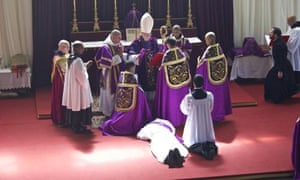
 At a secluded monastery outside Nova Friburgo in Brazil, a breakaway group of ultra-traditional Catholics has gathered to participate in an act of rebellion against the pope. Photograph: Jonathan Watts for the Guardian
Santa Cruz monastery brazil
Hailing from around the world, a group led by an excommunicated bishop call themselves a ‘resistance’ movement against Vatican reforms. The response from the Vatican was swift and unequivocal: ‘Excommunication is automatic’


In a secluded monastery in south-eastern Brazil, a breakaway group of ultra-conservative Catholics gathered to participate in an act of rebellion against the pope.
The setting could hardly have been more tranquil: rolling green hills, purple-glory trees, palm leaves swaying in the wind and a temporary chapel made of breeze block walls and a tin roof left partially open to the elements.
But the 50 or so priests, Benedictine monks, nuns and other worshippers who file into Santa Cruz monastery on Saturday were no ordinary congregation. Hailing from Europe, the US and Latin America, they described themselves as a “resistance” movement against Vatican reforms.
In favour of Latin services – and fiercely opposed to ecumenism, freedom of religion and closer relations with Judaism – they had come to defy the authority of Rome with the ordination of a new priest by an excommunicated bishop, Jean-Michel Faure.


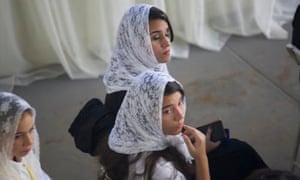
The ceremony harked back to an earlier, more conservative age. Women sat on one side of the aisle, their heads – even the youngest girls – covered in scarves. Over three hours, the liturgy was almost entirely in Latin, as were the hymns sung by a choir of monks accompanied by a nun on an electric organ.
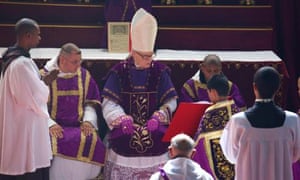
Before his ordination, brother André Zelaya de León prostrated himself before the altar and then rose to his knees for a blessing on his tonsured head by Faure. At times, the prayers were so quiet that they almost drowned out by the cicadas and birds in the trees.

After the mass, Faure told the Guardian the Vatican was smashing tradition, and going against the teachings of Pius X, a staunch conservative who was pope between 1903 and 1914.Apart from the digital cameras, cellphones – and the electric organ – the ceremony would have been recognisable to centuries of Catholic believers before what today’s ultra-conservatives consider to be the wrong turn taken by the Catholic church with the democratising reforms of the 1962 Second Vatican Council.
“We do not follow that revolution. The current pope is preaching doctrine denied by Pius X. He is less Catholic than us,” he said. “He does not follow the doctrine of the faith that are the words of Jesus Christ.”
The Vatican’s response to the ordination was unequivocal.
“Excommunication is automatic,” a spokesman said. He added: “For the Holy See, the diocese of Santa Cruz in Nova Friburgo does not exist. Faure can say what he wants, but a Catholic, and even more so a bishop, obeys and respects the pope.”
Faure, a French cleric who has worked in Mexico and Argentina, said he did not accept this ruling.
“Canon law states that excommunication is valid if it follows a mortal sin. But ours is not a mortal sin. We’re just following our religion. To do this, we need priests, and to have priests we need bishops.”
He compared his situation to that of other Catholics in history, such as Joan of Arc, who were initially excommunicated but later recognised for their contribution to the Church. “Although we are a minority now, if you look at history, we are a majority. There all the saints, 250 popes and all the Catholics who think exactly as we think.”


Santa Cruz monastary
Pinterest
 Women sat on one side of the aisle, their heads – even the youngest girls – covered in scarves. Photograph: Jonathan Watts for the Guardian

Faure said he only reluctantly become a bishop in case Williamson died in an accident, which would leave the group without the means to ordain priests.
Though he did not say it, the French bishop may also be replacing his British counterpart as a spokesman for the movement. Williamson has repeatedly stirred up controversy with comments denying the Holocaust, praising the Russian president, Vladimir Putin, as a peacemaker, warning that Muslims are taking over Europe, and claiming that women are dominating corporations and the military because they are not fulfilling their natural role “making babies”.
Williamson was one of four bishops illegally ordained in 1988 by a French Roman Catholic archbishop called Marcel Lefebvre, the founder of the Society of St Pius X and an outspoken critic of the liberalisation of certain church practices following the Second Vatican Council, including the widespread use of vernacular language rather than Latin in mass, inter-faith dialogue and efforts to communicate with the secular world.
Lefebvre and all four bishops were immediately excommunicated for participating in the illicit ordinations, but their movement has been a thorn in the Vatican’s side ever since.
Only about one million Catholics – or 0.1% of the Catholic population – describe themselves as followers of St Pius X, but successive popes have attempted to heal the rift with them.
In 2009, Pope Benedict ignited controversy by lifting the excommunication of the four bishops and even promised the rebel group autonomy from bishops they considered too liberal.
This quickly backfired when it was revealed that Williamson had alleged that no Jews were killed in gas chambers, that the US orchestrated the 9/11 terrorist attacks and that freemasons were conspiring to destroy Catholicism. 
The Vatican said at the time that Benedict had not been aware of Williamson’s views on the Holocaust. In 2012, Williamson was dismissed by the St Pius X fraternity in part because he disagreed with their willingness to communicate with Rome. Faure has also been ejected by the society and his ordination unrecognised.
“All the declarations of Bishop Williamson and Fr Faure prove abundantly that they no longer recognize the Roman authorities, except in a purely rhetorical manner,” the society said in a communique issued after his ordination.
In contrast to his predecessor, Pope Francis has paid little attention to the ultra-conservatives.
Williamson has declared that he does not intend to start a new society, but the movement has now created a new bishop and a priest, and Faure claimed that there were at least two bishops in the Society of St Pius X who sympathised with the self-styled “Resistance”.


Santa Cruz monastary
Pinterest
 A ceremony at the monastery outside Nova Friburgo in south-eastern Brazil. Photograph: Jonathan Watts for the Guardian

In conversation, the traditionalists appear to be hoping for a divine and dramatic intervention. Williamson, who describes himself as a “bloody-minded Brit”, has said he expects a “gigantic chastisement” such as Noah’s flood.
Faure talks more of a coming third world war.
“It would be horrible, but it would change the world. But the day after wouldn’t be like the day before,” Faure said, pointing to the conflicts in Ukraine, Syria and Iraq. “It would change many things in the world. It would be a new approach in many aspects and why not, in religion.”
For the moment, however, their group of roughly 55 rebel clergy has to rely on stubborn faith.
René Trincado, a priest from Chile, who was expelled from the Society of St Pius X in 2013 because he opposed an accord with the Vatican, is among those at the Santa Cruz monastery, which he described as the base of the resistance operations in Brazil.
“We’re not afraid of excommunication. It has no validity,” he said

Dominicans of Avrillé: Honey and Gall in Menzingen

Dominicans of Avrillé:  Honey and Gall in Menzingen
By Amicus Romanus                                                     SOURCE
Translation provided by Michael Fuller from Spanish


From the same mouth spews forth bitterness and gall and sweetness and honey, but not in the same direction. 

-Towards Bishop Williamson and Bishop Faure, it's all bitterness. 

-Towards conciliar Rome, it's all sweetness. 


The communiqué fromMenzingen regarding the March 19th consecration offers a truly impressive contrast. 

I. Only gall!

Joseph's brothers could not speak peaceably to him, as much as they looked on (Genesis 37:4). From Menzingen, don't expect one single kindhearted word of recognition or of charity towards Bishop Williamson or Bishop Faure, after their decades of good, loyal service.  Menzingen only thinks of denouncing them: "The SSPX denounces the episcopal consecration of Rev. Fr. Faure".  At least this is clear, but why this denunciation?  What is reprehensible in this consecration?  This is something much more sinister.  A very strong animosity is felt, but many rational arguments are not discerned.  And even worse: it tastes of bitterness!  Menzingen seems unable to speak objectively simply respecting the facts about the two bishops. At all costs, they must deform and dirty the intentions, dirty the reputation of people.  The tendency seems unstoppable. 

1. "Against any relations"

First example: the relations with Rome.  Everyone knows that Bishop Williamson and Bishop Fellay oppose each other on this point.  The former estimates (whether he is right or not is not the question here) that the latter lacks the necessary strength to decidedly oppose -face to face- the errors of the Roman authorities; instead of impressing his interlocutors -like Archbishop Lefebvre- by frontally reminding them of the inopportune truths, he lets himself be impressed by them. 

More fundamentally, the opposition is about the finality of the negotiations. For Bishop Williamson, there is only one objective: that the Roman authorities abjure from all the modernist and liberal errors and everything that has resulted.  Meanwhile, Bishop Fellay dreams of a canonical recognition, even before the conversion of the authorities. 

All of this is notoriously public.  The question is not to know if it is necessary or not to discuss with Rome, but how and with what finality to go about with these discussions. 

Menzingen could easily say it in one word: Bishop Fellay and Bishop Williamson differ regarding the discussions with Rome.  This is clear, simple, true, and perfectly objective. 

But no! Menzingen could not be resolved to call it how it is.  The necessity to dirty the reputation was too violent.  Distrusting the evidence, Menzingen declared that Bishop Williamson and Bishop Faure are "against any relation with the Roman authorities".  But they have explicitly declared the contrary (even on the eve of the consecration), but that doesn't count.  Apparently, Menzingen knows more about what they themselves think!

2. "It is not at all comparable"

Second example: the comparison between the 1988 consecration and the 2015 consecration.  The differences and similarities can be argued a long time.[i] At least it is unarguable that the nature of the act is the same.  There was a paternal link (through Bishop Williamson, Archbishop Lefebvre is now the "grandfather in episcopacy" of Bishop Faure).  Archbishop Lefebvre himself had contemplated consecrating Jean-Michel Faure.  The state of necessity in the Church has not diminished since 1988.  Finally, Bishop Williamson has the same discourse that Archbishop Lefebvre had at the time. 

Different circumstances of times, places, or manner can always be disputed, but Menzingen doesn't even attempt it.  Their communiqué simply declares that "the episcopal consecration of Fr. Faure is not at all comparable with the consecrations of 1988".  You read that right: not at all.

Among all the ways of criticizing the 2015 consecration, Menzingen chose the most expedient, the most extreme, the most insupportable, to reject as a whole.  "It is not at all comparable."  It is integral negationism.

3. "All the declarations..."

We approach the apex.  And here finally "all the declarations of Bishop Williamson and Rev. Fr. Faure prove abundantly that they no longer recognize the Roman authorities".  

This is the accusation that kills: sedevacantism!  An outright accusation alleged without even a minimal, faint shadow of a doubt.  We are very far from interrogative-negative formulas or from the dimmed allusions of Bishop Fellay when he tries to emit reserves about Pope Francis (we don't understand...", "We have the impression...").  Here Menzingen understands very well and is certain.  This confession was not made once, by surprise or by halfhearted words, it's in "all the declarations" of the wicked bishops.  Yes all of the declarations!  Faith in Menzingen!

Moreover, Menzingen realizes that there might be, among the readers of the communiqué, some readers of Bishop Williamson that can be a little surprised because they have read exactly the opposite.  Not only does Bishop Williamson recognize the Roman authorities, but he has frequently argued against sedevacantism (and in a more convincing way than Bishop Fellay, who is content with presenting it as a scarecrow).

Those who have read Fr. Faure (notably the interview before his consecration) can experience the same surprise, and even think that good Bishop Fellay lies, or at least that he says just about anything.

Happily, the bile reserve has not run dry.  To prevent against any embarrassing question, it is sufficient to accuse them, Bishop Williamson and Bishop Faure, of lying.  All of their declarations affirm that they recognize the Roman authorities?  It doesn't matter!  It is simply that they don't believe what they say.  They are only words in the air, empty, rhetorical spins.  And Menzingen, which really knows better than what they themselves are thinking, finishes:  "All the declarations [...] prove abundantly that they no longer recognize the Roman authorities, except in a purely rhetorical manner".

This is what we call, in good French, a judgment of intention.  It is the preferred tactic of subversives (communists, masons, etc.), because it is very difficult to counteract.  You all can respond however you like, it matters little, because we have put forward the principle that you do not really believe what you say.  State ten times that you recognize the Roman authorities, undertake the work of refuting the sedevacantist arguments: we content ourselves with responding that your insistence on this point is suspicious and confirms, once more, that you don't absolutely recognize the mentioned authorities "except in a purely rhetorical manner".

A simple question for Bishop Fellay: conscientiously and before God, is it truly correct that this polemical procedure is in complete conformity with the Gospel?

II. Only honey!

But the most impressive is the contrast.

After all, Menzingen could be suffering from a toothache or had a bad night when they wrote up their communiqué.  This could explain the bitterness. 

But the sweetness?

Well, reread attentively: is it not evident that they have left out from this communiqué any expression that could constitute a minimal possibility of risk of displeasing conciliar Rome?

1.  “State of necessity” without an identifiable cause.

“The Society of St. Pius X still maintains that the present state of necessity renders legitimate its action throughout the world”.—But where does this state of necessity come from?  It seems to float in the air without a cause and without an explanation other than the evil of the times.  Menzingen mentions it as if it verifies the rain or the sun and does not remember even once that the harm comes firstly from the pope and the Holy See that propagate, since 50 years ago, mortal errors to souls.

-Shush! Shush! Warning! You are going to offend Rome!

2.  The limited bishops and the administering of the sacraments.

Archbishop Lefebvre consecrated bishops so that they could ordain priests, this is certain, but also to defend the faith and combat the current errors, moreover, the modernist and liberal errors spread by the conciliar hierarchy.

Apparently, this has ended.  For Menzingen, the bishops must no longer combat the errors.  The communiqué explains that Archbishop Lefebvre consecrated bishops in 1988 and “his sole goal was to make available to the faithful the sacraments which priests ordained by the bishops would offer”.

“[T]he sole goal”: the state of necessity in the Church is limited to the sacraments- and what about the doctrinal crisis?  What about the errors of conciliar Rome, the neo-modernist and neo-protestant tendency so frequently denounced by Archbishop Lefebvre?

-Shush! Shush! Warning! You are going to offend Rome!

3.  Errors that who knows from whence they come.

Nevertheless, there are errors. Menzingen indicates that it is necessary to oppose them.  In its martial fit of rage, the communiqué goes all the way to valiantly declaring that the Society must oppose the errors “from wherever they may come”!  And just from where do they come?  They won’t tell us anything else!

-Shush! Shush! Warning! You are going to offend Rome!

Bishop Fellay, accused by Bishop Williamson of gleaming in front of conciliar Rome, should have taken advantage of the occasion to prove otherwise.  Some words against the neo-modernist and neo-protestant Rome would have been particularly adequate.  The very situation even seemed to require it. But no!  Not a single word.  Bishop Williamson and Bishop Faure are scorned, but modernist Rome is in no way denounced.

And regarding this, one of the two applies:

·         Either (a suspected plotter) whoever the newly responsible for the communiqué from Menzingen was is a secret ally of Bishop Williamson: he treacherously works to discredit Bishop Fellay publishing, in his name, communiqués crafted liberally (sickly-sweet for the enemies of the faith, bitter for its defenders).

·         Or the communiqué really expresses the way Bishop Fellay thinks, and so the joy that Archbishop Pozzo promptly directed to the SSPX for this beautiful communiqué is understood.

P.S. Secondary consideration

It is curious that Menzingen always expresses itself as if the state of necessity that afflicts the Church was its own territory or its private property.  Only the SSPX can seemingly invoke it in order to justify its apostolate.

Lastly, Menzingen seems to attribute to itself a supreme, extraordinary jurisdiction almost like the pope exercises the supreme ordinary jurisdiction.  This perspective would explain the reason that Menzingen believes it is authorized to “denounce” the consecration of Bishop Faure: an attempt against its monopoly.

If this is not the case, well then what is it?  A personal prelature already agreed upon by Rome -secretly- to Bishop Fellay?

_________________________________


[i] Regarding the differences, Menzingen emphatically underlines “some hundreds of journalists from around the world” that were present in 1988.  Visibly, for Bishop Fellay this is very important.  We need to ask him if the journalists -in his opinion- were present for the first episcopal consecration on the night of Holy Thursday.